" What makes this role truly rewarding is not just running experiments,
but being able to directly interpret genotyping results. "
Q1
Please introduce yourself.
Hello, I am the Head of the Testing Team at Theragen Health. I have been with the company for approximately n years.
Q2
What are your main responsibilities?
As a team leader, I focus more on scheduling and troubleshooting rather than hands-on tasks.
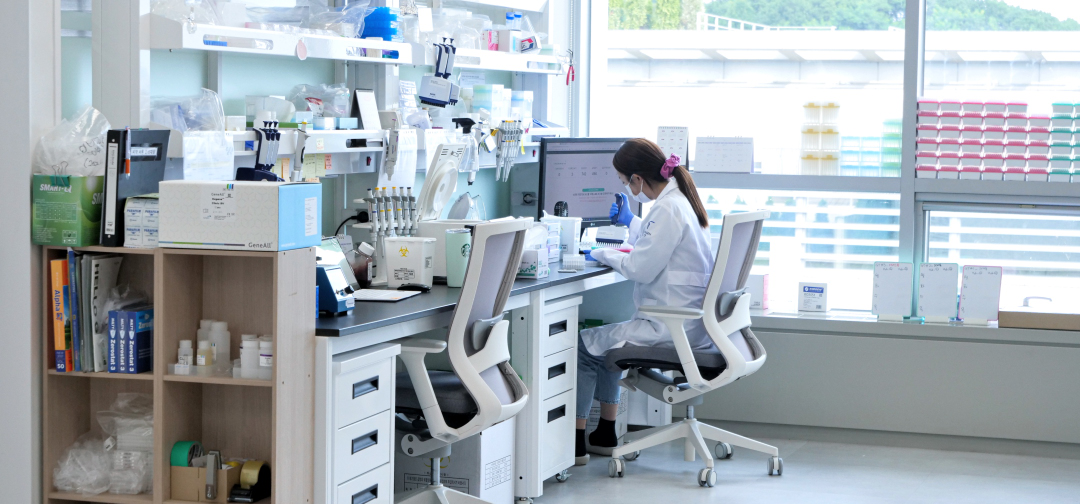
For pet genetic testing, I am still directly involved in experiments, managing DNA extraction and the overall process.
At the same time, my role is to support team members by encouraging them to share ideas and grow together.
Q3
What does a typical day look like for you?
Our day starts earlier than most teams due to lab schedules.
From early morning, we complete the first round of experiments and check whether previously prepared samples are ready for further testing.
Before lunch, we proceed with additional DNA extraction and take a break with the team.
In the afternoon, I manage experiment schedules based on the extracted samples, receive new specimens, and complete DNA extraction from buccal swab samples before wrapping up the day.
Q4
When do you feel most rewarded in your work?
Since lab work is often repetitive, I feel the most fulfillment when my team successfully completes challenging experiments.
It is especially rewarding when team members take initiative, propose solutions, and solve issues together rather than relying solely on direction from a leader.
Q5
What is the most attractive part of your role?
In many lab roles, results are often limited to pass or fail outcomes.
However, in this role, I can directly interpret genetic variations and genotyping results, which adds much greater value and meaning.
Additionally, through large-scale government projects, we have handled high-volume samples - up to 6,000 to 7,000 cases in a short period - allowing us to build strong operational capabilities and a sense of responsibility.
Q6
How would you describe the work environment at Theragen Health?
With more young professionals joining the company, the traditionally rigid atmosphere of the bio industry has become more relaxed and open.
Although there can be generational gaps, they are balanced by team members who act as bridges.
In particular, our testing team emphasizes self-evaluation and knowledge sharing, helping both individual growth and smoother adaptation to the company.
Q7
How are you preparing for your career growth?
I felt that focusing only on experimental work could limit my career growth, so I decided to study new fields.
Currently, I am pursuing graduate studies while working. Although it is challenging, I see it as a way to upgrade myself.
I aim to deepen my expertise and eventually expand into bioinformatics-based genomic analysis.
Q8
Any advice for those preparing for a similar role?
First, it is important to build a strong foundation in molecular genetics.
More than technical skills, a willingness to learn and a proactive mindset are essential.
Technical skills will naturally develop with experience, but advancing beyond that requires strengthening theoretical knowledge.
Additionally, since lab roles can have limited exposure to the market,
I recommend participating in genomics conferences to broaden your perspective.








Q1
Please introduce yourself.
Hello, I am the Head of the Testing Team at Theragen Health. I have been with the company for approximately n years.
Q2
What are your main responsibilities?
As a team leader, I focus more on scheduling and troubleshooting rather than hands-on tasks.
For pet genetic testing, I am still directly involved in experiments, managing DNA extraction and the overall process.
At the same time, my role is to support team members by encouraging them to share ideas and grow together.
Q3
What does a typical day look like for you?
Our day starts earlier than most teams due to lab schedules.
From early morning, we complete the first round of experiments and check whether previously prepared samples are ready for further testing.
Before lunch, we proceed with additional DNA extraction and take a break with the team.
In the afternoon, I manage experiment schedules based on the extracted samples, receive new specimens, and complete DNA extraction from buccal swab samples before wrapping up the day.
Q4
When do you feel most rewarded in your work?
Since lab work is often repetitive, I feel the most fulfillment when my team successfully completes challenging experiments.
It is especially rewarding when team members take initiative, propose solutions, and solve issues together rather than relying solely on direction from a leader.
Q5
What is the most attractive part of your role?
In many lab roles, results are often limited to pass or fail outcomes.
However, in this role, I can directly interpret genetic variations and genotyping results, which adds much greater value and meaning.
Additionally, through large-scale government projects, we have handled high-volume samples - up to 6,000 to 7,000 cases in a short period - allowing us to build strong operational capabilities and a sense of responsibility.
Q6
How would you describe the work environment at Theragen Health?
With more young professionals joining the company, the traditionally rigid atmosphere of the bio industry has become more relaxed and open.
Although there can be generational gaps, they are balanced by team members who act as bridges.
In particular, our testing team emphasizes self-evaluation and knowledge sharing, helping both individual growth and smoother adaptation to the company.
Q7
How are you preparing for your career growth?
I felt that focusing only on experimental work could limit my career growth, so I decided to study new fields.
Currently, I am pursuing graduate studies while working. Although it is challenging, I see it as a way to upgrade myself.
I aim to deepen my expertise and eventually expand into bioinformatics-based genomic analysis.
Q8
Any advice for those preparing for a similar role?
First, it is important to build a strong foundation in molecular genetics.
More than technical skills, a willingness to learn and a proactive mindset are essential.
Technical skills will naturally develop with experience, but advancing beyond that requires strengthening theoretical knowledge.
Additionally, since lab roles can have limited exposure to the market,
I recommend participating in genomics conferences to broaden your perspective.